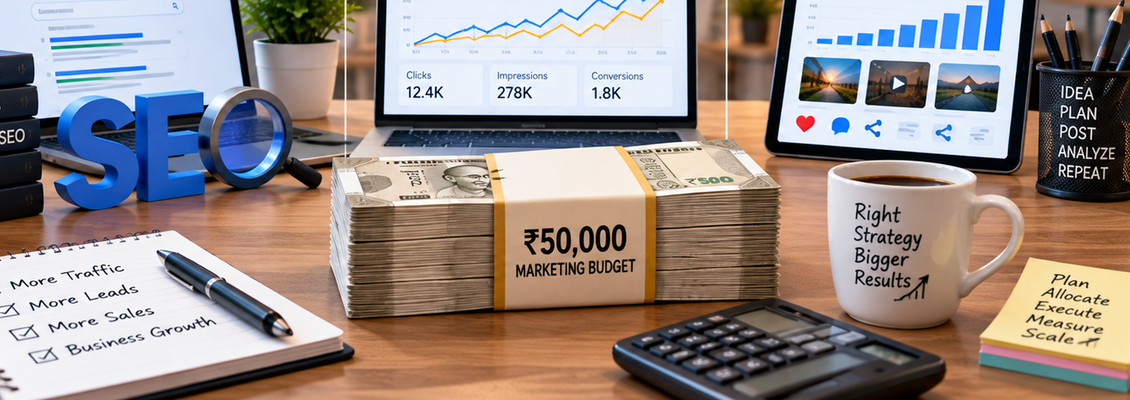
Every business owner reaches a moment where the marketing budget is finally real money, not a wishlist. If you've just set aside your first ₹50,000 for growth, you're probably staring at three tabs open on your laptop: SEO, Google Ads and social media, all promising to be the answer. Ask any digital marketing Sydney business owner and they'll tell you the same thing — the channel you pick first can either compound for years or evaporate the moment you stop paying. This guide breaks down exactly where that first rupee should go, and why.
Three Channels, One Budget, Zero Room for Guesswork
Before splitting a single dollar, it helps to understand what each channel actually does. Search engine optimization builds organic traffic and search rankings over months, not days. Paid search — Google Ads — buys instant visibility for as long as you keep paying cost per click. Social media campaigns build brand awareness and audience engagement, turning followers into a warm audience for later. None of these are inherently "better." They're built for different timelines, and a smart marketing campaign usually blends them once the budget allows.
Why SEO Often Deserves the First Rupee
Organic traffic doesn't switch off when your ad spends runs dry, which is exactly why many digital marketing experts recommend SEO as the foundation layer. Working with a team like Organic SEO Guru means your ₹50,000 goes toward search rankings, link building and technical fixes that keep working long after the invoice is paid. Unlike paid search, where cost per lead resets every month, SEO gradually lowers your cost per lead over time as rankings mature. For businesses playing the long game, this compounding effect is hard to beat.
Where Google Ads Genuinely Wins
That said, paid search has a superpower SEO can't match: speed. If you need leads this week, not this quarter, Google Ads delivers immediate placement at the top of search results. A well-structured marketing campaign here uses tight keyword match types, strong conversion tracking, and clear cost per click targets to avoid wasted spend. This is where a digital marketing agency in Sydney typically earns its fee — not by spending your budget, but by protecting it:
- Setting realistic cost per lead benchmarks before launch
- Pausing underperforming ad groups fast
- Using conversion tracking to attribute every rupee to a result
Social Media's Real Job Isn't Sales
Social media campaigns rarely close to a ₹50,000 deal on day one, and treating them as a direct-response channel is where most budgets get wasted. Their real strength is brand awareness and audience engagement — staying visible while a prospect compares three quotes before choosing. Organic SEO Guru positions social content as the supporting act: it warms up the audience that search rankings and paid search bring in, rather than competing with them for lead generation credit.
Cost per Click vs Cost per Lead: the Numbers That Matter
Every digital marketing Sydney business eventually has to compare apples to apples. Cost per click tells you what you paid for attention; cost per lead tells you what you paid for a real opportunity. SEO has no per-click cost but a longer runway to results. Google Ads has an immediate, trackable cost per lead but stops the moment spend stops. Conversion tracking across both channels is non-negotiable — without it, a marketing campaign is just an expensive guess dressed up as strategy.
Regional Businesses Need a Regional Strategy
For businesses outside the CBD, generic national campaigns rarely convert as well as locally optimized ones. This is where digital marketing Sydney strategy needs to get specific — a Wollongong plumber and a North Shore accountant are chasing completely different search intent, even under the same city banner. Organic SEO Guru builds location-aware SEO campaigns that treat organic traffic and search rankings as hyper-local assets, not broad national ones, which matters enormously when your first ₹50,000 has zero room for wasted impressions.
A Simple Framework for Splitting Your First ₹50,000
Rather than picking one channel and ignoring the rest, most digital marketing experts recommend a staged split based on urgency and runway:
- Need leads within 30 days? Weight spend toward paid search with tight conversion tracking
- Building a business for the next 3-5 years? Prioritize SEO, link building and search rankings
- Want to stay visible while other channels work? Run modest social media campaigns for brand awareness alongside either option
Organic SEO Guru typically recommends 50-60% toward SEO foundations, with the remainder split between paid search and social media campaigns based on how fast you need lead generation results.
Why Combining Channels Beats Choosing One
The businesses that grow fastest rarely rely on a single channel forever. A digital marketing agency in Sydney worth hiring will show you how organic traffic from SEO lowers your reliance on paid search over time, while social media campaigns keep audience engagement warm in the background. This layered marketing campaign approach means your cost per lead drops year over year, instead of staying flat because you're only ever paying for clicks.
So, Which Channel Gets the Green Light?
There's no universal right answer, but there is a smarter starting point than flipping a coin. If your business can survive a few months of building momentum, SEO gives your ₹50,000 the longest shelf life. If you need proof of concept fast, paid search earns its keep — just track every cost per click and cost per lead ruthlessly. And whatever you choose, don't sideline social media entirely; audience engagement today becomes lead generation tomorrow. Organic SEO Guru builds these decisions around your current timeline, not a one-size-fits-all template, so your first big marketing spend works as hard as the ones that follow it.